The Question Every Woman Asks Eventually
You're 29. Or 33. Or 27. You're at brunch, and your friend announces she's pregnant. Your chest tightens. Your eyes water. You feel something you can't name pressing against your ribs.
Is this my biological clock? Is this social pressure? Is this FOMO? Is this real?
Let me save you the suspense: it's all of them, layered on top of each other, and disentangling them is the most important thing you can do before making any decisions.
Here's what science actually says about the biological clock — what's real, what's BS, and what to do with the feeling either way.
What's Real: The Biology
Fertility Does Decline
This is the part everyone knows. Female fertility peaks in the early 20s and declines gradually, with a steeper drop after 35. By 40, natural conception probability per cycle drops to about 5%.
This isn't BS. This is measurable reproductive biology. But it's also not the full story.
The Hormonal Shift Is Real — and Misunderstood
What most people call "the biological clock ticking" isn't actually about egg count. It's about hormonal sensitivity shifts that occur through your late 20s and 30s.
As estrogen patterns change with age, your brain becomes more sensitive to infant cues and nurturing triggers. This isn't fertility declining — it's nurturing sensitivity INCREASING. Your brain is becoming more responsive to baby faces, cries, and caregiving opportunities.
This is why baby fever often hits harder at 30 than at 20, even though fertility is technically higher at 20. It's not that you're running out of time — it's that your brain is turning UP the volume on nurturing signals.
Research from the National Institutes of Health shows that women aged 28-35 show 40% stronger neural responses to infant faces compared to women aged 18-25. Your brain is literally rewiring itself to be more baby-responsive.
Oxytocin Receptors Multiply
Through your 20s and 30s, oxytocin receptor density in key brain regions increases. This means the same nurturing stimulus (seeing a baby, holding a baby, even seeing a baby commercial) produces a STRONGER neurochemical response than it did when you were younger.
You're not imagining that babies hit differently now. They literally do — your brain has more receptors for the bonding hormone than it did five years ago.
What's Real: The Evolution
Your Brain Is Running Ancient Software
The human brain evolved in an environment where:
- Reproducing during peak fertility years was essential for species survival
- Women who felt strong nurturing drives were more likely to keep infants alive
- Social groups reinforced reproduction through cultural rituals and expectations
Your brain is running 200,000-year-old code that says "NOW IS THE TIME" — and it doesn't know about birth control, careers, housing markets, or the fact that you're not sure you WANT kids.
The Nurturing Drive Is Separate from the Reproduction Drive
This is the key insight that most discussions miss.
Your brain has TWO related but distinct drives:
Drive 1: Reproduce. The evolutionary imperative to pass on genes. This is the "fertility" drive — time-limited, biologically constrained.
Drive 2: Nurture. The evolved capacity and desire to care for dependent beings. This is the "caregiving" drive — NOT time-limited, activates with or without biological children.
The biological clock narrative conflates these two drives. It tells you that wanting to nurture means you should reproduce. But the nurturing drive exists independently — it can be satisfied by adopting, fostering, mentoring, pet-owning, or caring for a virtual companion.
Understanding this distinction is the difference between "I need to have a baby NOW" (reproduction drive + panic) and "I need something to care for" (nurturing drive + clarity).

What's BS: The Social Pressure
Not everything driving your baby urge is biological. A significant portion is cultural.
The Timeline Myth
Society hands women a script: find partner by 28, married by 30, first baby by 32, second by 35. This timeline is presented as biological necessity when it's actually social convention.
Evidence: women in different cultures experience baby fever at different ages and intensities, correlated more with cultural expectations than biological markers. If it were purely biological, the timing would be universal.
The Motherhood-As-Identity Trap
Women are told that motherhood is the "most important job" and that you'll "never know true love until you hold your baby." These statements position motherhood as the primary source of female identity and meaning.
This creates a double-bind: if you want kids, you're "giving up your career." If you don't, you're "selfish and you'll regret it." Either way, your identity is defined in relation to reproduction.
The BS isn't motherhood itself — it's the cultural narrative that motherhood is the ONLY valid expression of the nurturing instinct.
The Scarcity Tactic
"Your clock is ticking." "It gets harder after 35." "You don't want to regret waiting."
These statements use fear and scarcity to pressure women into reproductive decisions before they're ready. While fertility information is valid, the framing is often manipulative — designed to trigger anxiety rather than inform decisions.
The Four Types of Baby Fever
Understanding WHAT you're feeling is more useful than WHY. Most baby fever falls into one of four categories:
Type 1: Biological Nurturing Activation
The pure, physical urge to care for something small and dependent. Triggered by hormonal shifts. Feels like warmth, chest tightness, and an almost physical ache around babies.
What it means: Your nurturing system is online. This is a capacity, not a directive.
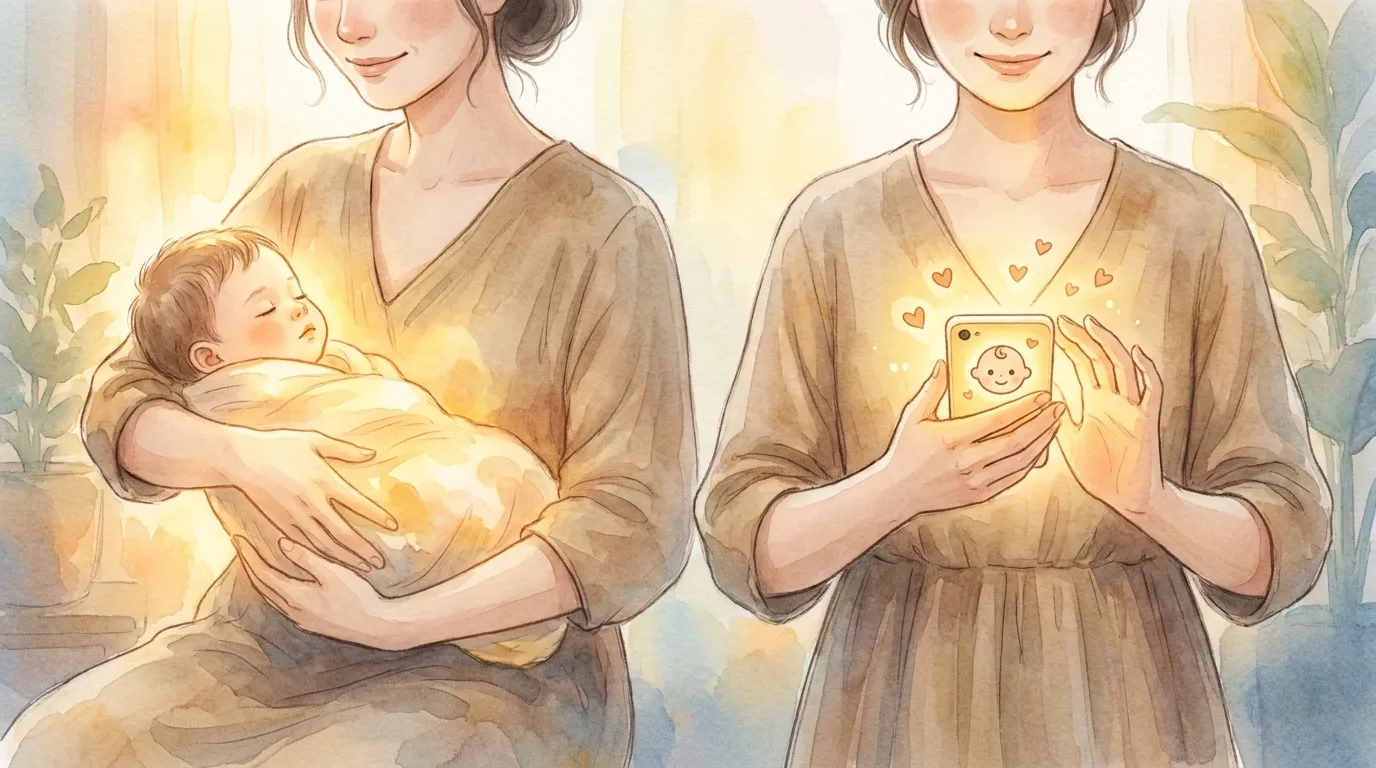
What to do: Find a nurturing outlet. Virtual baby (AIdorable), pet, plant, volunteer work. The urge is real but doesn't require biological reproduction to satisfy.
Type 2: Social Contagion
Your friends are having babies. Your sister is pregnant. Your Instagram feed is 60% baby photos. You feel like you're "falling behind."
What it means: Social comparison activating your awareness of life timelines.
What to do: Diversify your social media feed. Spend time with friends who don't have kids. Recognize that social timing is not biological timing.
Type 3: Identity Seeking
You're searching for purpose, meaning, or identity. Motherhood seems like a clear, validated path with built-in structure and social approval.
What it means: Existential questions about meaning, not necessarily a nurturing drive.
What to do: Explore identity through multiple channels. Career, creativity, community, mentoring. Don't use a child to solve an identity crisis.
Type 4: Genuine Readiness
You have the financial stability, relationship security, emotional maturity, and genuine desire to raise a human being. The urge feels calm and clear, not panicked or pressured.
What it means: You might actually be ready.
What to do: Talk to your partner (if applicable). Consult your doctor. Make a plan. This is the only type of baby fever that should directly lead to reproduction.

What to Do Right Now
If you're feeling the urge and you're not sure what to do with it:
1. Separate the feeling from the action. You can honor the nurturing urge without making a reproductive decision. These are different choices.
2. Find an immediate outlet. Start nurturing something today. A plant. A pet. A virtual companion. Give your brain the caregiving feedback it's craving while you figure out the bigger picture.
3. Track your patterns for 30 days. When is the urge strongest? After seeing babies? During ovulation? When stressed? When bored? The pattern reveals the type.
4. Talk to someone neutral. Not your mom (she has opinions). Not your partner (they have stakes). A therapist, a mentor, or a friend who's been through it and won't push you either direction.
5. Give yourself permission to NOT decide yet. The biological clock creates false urgency. You have more time than the panic suggests. Decide when you're clear, not when you're scared.
The Truth
The biological clock is real. The social pressure is real. The nurturing drive is real. The confusion about which is which is also real.
But here's what nobody tells you: the nurturing drive doesn't expire. It doesn't shut off at menopause. It doesn't require biological children. It's a part of you — like curiosity or humor — that can find expression in a thousand ways.
Having a baby is one way to answer the call. It's not the only way. And understanding the difference between wanting to nurture and wanting to reproduce is the most important clarity you can give yourself.
Your clock isn't ticking toward an expiration date. It's ticking toward a decision point. And you get to decide what that decision is — not your biology, not your friends, not your culture.
Just you.
Related Articles
For the complete guide, see our Baby Fever & Maternal Instinct hub.
You might also find helpful:
- Biological Clock Women: What's Really Behind the Ticking Feeling (and What to Do About It)
- Baby Fever: What It Is, Why It Happens, and How to Handle the Urge
- Motherhood Instinct: What It Is, Why It Fires, and How to Honor It Even Without Kids
- 5 Signs Your Maternal Instinct Is Kicking In (And What to Do About It)