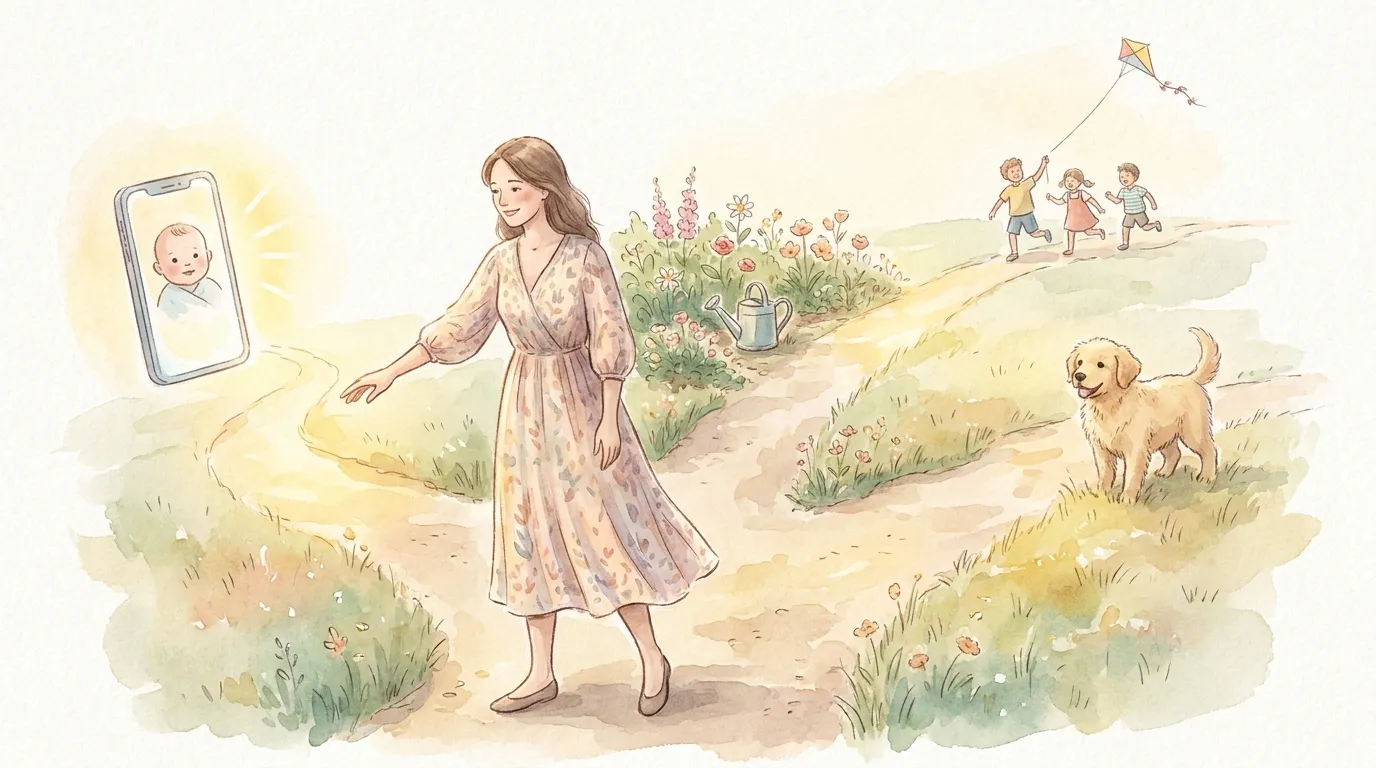
The Feeling Is Real. The Solution Doesn't Have to Be a Baby.
Baby fever is not a metaphor. It's a neurological event — oxytocin flooding your system, your brain's nurturing system screaming "CARE FOR SOMETHING SMALL," and your rational mind going "but I'm not ready / I can't afford it / I'm single / I just started my career / I'm not sure I even WANT kids."
Here's what nobody tells you: you don't have to satisfy baby fever with an actual baby.
The nurturing drive and the reproductive decision are two different things. The drive says "care for something dependent." The decision says "create or adopt a human being." You can honor the drive without making the decision.
Here are 7 outlets that actually work, ranked by how well they satisfy the urge.

Understanding the Nurturing Drive
Before we get to the solutions, it helps to understand what baby fever actually IS at a neurological level.
Baby fever isn't a single feeling — it's a constellation of neurochemical signals that collectively create an intense urge to nurture. The primary drivers:
- Oxytocin craving: Your brain wants the bonding hormone that comes from caregiving. Without regular nurturing input, your oxytocin baseline drops, creating a physiological deficit that feels like emotional hunger.
- Estrogen-mediated nurturing activation: In women of reproductive age, estrogen sensitizes the brain's nurturing circuits. This isn't a cultural phenomenon — it's documented across cultures and even across species.
- Dopamine-seeking through caregiving: The reward pathway in your brain has learned that caregiving produces dopamine. When you're not caregiving, that pathway goes underutilized, creating a craving similar to any other reward deficit.
Understanding this helps because it means baby fever isn't irrational. It's your brain requesting a specific neurochemical input. And you can provide that input through channels other than biological reproduction.
1. Virtual Baby (AIdorable) — Best Overall
Commitment: 2-5 min/day Cost: Free / $4.99/mo Satisfaction: ★★★★★
AIdorable was literally designed for this. You adopt a virtual baby who develops personality based on your caregiving style. The baby grows through stages (newborn → infant → toddler), hits milestones, and the AI writes journal entries about your relationship.
Why it's #1: It's the closest thing to actual baby care without any of the real-world consequences. The oxytocin release is real. The daily routine is real. The emotional attachment is real. The only thing that isn't real is the 18-year commitment and the $300,000 cost.
What users report: "I didn't expect to actually feel attached. But after two weeks, I genuinely looked forward to feeding my baby every morning. The baby fever didn't disappear — it just had somewhere to go."
2. Pet Adoption — Most Tangible
Commitment: Daily Cost: $500-2000/year Satisfaction: ★★★★★
A real, breathing animal that depends on you completely. The oxytocin release from petting a dog or cat is well-documented. The routine of feeding, walking, and caring for a pet provides the daily nurturing structure that baby fever craves.
The caveat: Pets are a 10-20 year commitment. Don't get a pet just for baby fever — get one because you genuinely want to care for an animal for its entire life.
Best for: People whose living situation and finances support pet ownership.
3. Babysitting for Friends — Most Realistic
Commitment: Weekly or biweekly Cost: Free (you're helping!) Satisfaction: ★★★★☆
Offer to watch your friends' kids regularly. You get real baby time — the smell, the weight, the sounds — without any of the responsibility when you go home.
Why it works: Real baby interaction produces the strongest possible oxytocin response. But knowing you're handing the baby back at the end of the evening keeps the commitment manageable.
The bonus: Your friends will love you forever.
4. Volunteering with Children — Most Meaningful
Commitment: Weekly Cost: Free Satisfaction: ★★★★☆
Hospital baby cuddling programs, after-school tutoring, mentoring through Big Brothers Big Sisters, Sunday school teaching, community center volunteering.
Why it works: You get consistent nurturing time with real children while contributing to your community. The children benefit, you benefit, and the baby fever has a productive channel.
Best for: People who want nurturing with social impact.
5. Plant Parenting — Most Accessible
Commitment: Daily (5 min) Cost: $20-100 initial Satisfaction: ★★★☆☆
Start with easy plants (pothos, snake plant, monstera) and build a small indoor garden. Watching things grow under your care provides a gentle, consistent nurturing satisfaction.
The limitation: Plants don't respond emotionally. The oxytocin release is weaker than with responsive beings. But the routine, the visible growth, and the caretaking satisfaction are real.
6. Foster Parenting — Most Impactful
Commitment: Full-time (temporary) Cost: State-supported Satisfaction: ★★★★★
Foster parenting provides the full parenting experience — real children who need real care — with the understanding that the arrangement is temporary. It's the most impactful way to channel nurturing energy.
The caveat: This is not a casual commitment. Foster children have experienced trauma and need skilled, supported caregiving. Only pursue this if you've done serious preparation and have support systems in place.
7. Nurture-Focused Creative Projects — Most Flexible
Commitment: Daily (flexible) Cost: Varies Satisfaction: ★★★☆☆
Write a children's book. Create a baby-focused blog. Design a nursery (even a hypothetical one). Paint. Knit baby clothes. Channel the nurturing energy into creative output.
Why it works: Creative projects redirect the emotional energy of baby fever into productive expression. The act of creation activates the caregiving pathways differently — you're nurturing something into existence.
The Comparison
| Outlet | Satisfaction | Commitment | Cost | Reversibility |
|---|---|---|---|---|
| Virtual baby (AIdorable) | ★★★★★ | 2 min/day | Free/$5 | Complete |
| Pet adoption | ★★★★★ | Daily | $1K+/yr | Low |
| Babysitting | ★★★★☆ | Weekly | Free | Complete |
| Volunteering | ★★★★☆ | Weekly | Free | Complete |
| Plant parenting | ★★★☆☆ | Daily | $50 | Complete |
| Foster parenting | ★★★★★ | Full-time | Supported | Low |
| Creative projects | ★★★☆☆ | Flexible | Varies | Complete |


Why Virtual Nurturing Works Better Than You'd Expect
The biggest objection to virtual nurturing: "It's not real."
Here's the neuroscience response: your brain doesn't care.
Oxytocin release is triggered by caregiving BEHAVIOR, not by the biological reality of the recipient. When you feed a virtual baby and it smiles at you, your brain releases oxytocin. When you miss a day and your baby is sad, your brain releases guilt. When you come back and comfort the baby, your brain releases relief and bonding hormones.
These are the same neurochemical responses as real caregiving. Not similar — the same. The pathways evolved for real babies, but they activate with ANY responsive nurturing behavior. Your brain is running 200,000-year-old code that doesn't have a "real vs. virtual" filter.
This isn't delusion. It's neurochemistry. And it works.
The 30-Day Baby Fever Protocol
If baby fever is hitting hard right now, try this:
Week 1: Download AIdorable. Feed your baby every morning for 2 minutes. Notice how you feel before and after.
Week 2: Add one more real-world outlet — babysit once, visit an animal shelter, start a small plant collection.
Week 3: Evaluate. Has the intensity decreased? Most women report 50%+ reduction by week 3 with daily virtual nurturing.
Week 4: Decide. Is this satisfying enough, or do you feel genuinely ready for something more? There's no wrong answer.
Baby Fever Is Not Your Enemy
The feeling that's making you stare at strollers and well up at diaper commercials isn't weakness. It's your brain telling you that you have an extraordinary capacity for nurturing — a capacity that most people never fully activate.
Whether you channel that capacity into a virtual baby today, a foster child next year, or a biological child in five years... the capacity is the same. The nurturing instinct doesn't expire. It waits.
Give it somewhere to go. Something small. Something that needs you. Even something made of pixels and code.
Because the feeling isn't asking for a lifetime commitment. It's asking for two minutes of care. And once you give it that — consistently, daily — something remarkable happens.
The ache gets quieter. Not gone. Just... manageable. Like a fire that found its hearth.
You don't have to have a baby to be a nurturer. You just have to nurture.
Related Articles
For the complete guide, see our Baby Fever & Maternal Instinct hub.
You might also find helpful: