Have You Ever Felt It?
That sudden, almost physical ache when you see a baby in a stroller. The way your chest tightens when a friend announces her pregnancy. The quiet voice in the back of your mind whispering: "I want one."
Baby fever is real. And if you've ever felt it — sometimes intensely, sometimes as a gentle pull — you're not alone, and you're definitely not crazy. For the full picture, see our complete baby fever guide.
"Baby fever is this idea that people — both men and women — have this almost physical yearning to have a child." — Dr. Gary Brase, psychology researcher, Kansas State University
In this article, we'll break down what baby fever actually is, why your brain does this to you, and — most importantly — what you can do about it when you're just not ready yet.
What Is Baby Fever, Exactly?
Baby fever isn't a medical diagnosis. It's the common term for an intense, emotional desire to have a baby. It can hit anyone, but research shows it's especially common in women between ages 20 and 35.
Researchers at Kansas State University have actually studied this phenomenon extensively. In a series of studies published in the journal Emotion, they found that baby fever operates independently from the desire for sex or romantic partnership — it's its own distinct emotional experience.
Here's what baby fever typically feels like:
- A strong emotional reaction to seeing babies or pregnant women
- Fantasizing about having a child of your own
- Feeling a physical "ache" or yearning in your chest
- Increased attention to baby products, names, or nursery designs
- A sense that something is "missing" from your life
Sound familiar? You're experiencing something that millions of women go through — and there's a neurological reason for it.
The Neuroscience: Why Your Brain Wants a Baby
Your baby fever isn't random. It's the result of millions of years of evolutionary programming, and it's surprisingly well-understood by science.
The Hormone Cocktail
When you see a baby — or even just a picture of one — your brain releases a powerful mix of hormones:
| Hormone | What It Does | Effect |
|---|---|---|
| Oxytocin | The "bonding hormone" | Creates feelings of attachment and warmth |
| Dopamine | The "reward chemical" | Makes nurturing feel pleasurable and satisfying |
| Estrogen | Amplifies nurturing drive | Increases sensitivity to infant cues |
| Progesterone | Promotes maternal behavior | Enhances protective instincts |
This cocktail is designed by evolution to make you want to care for offspring. And it works really well — even when you're not actually planning to have a baby.
The Evolutionary Purpose
From an evolutionary standpoint, baby fever makes perfect sense. For hundreds of thousands of years, humans who felt a strong urge to reproduce were more likely to pass on their genes. The women who felt that pull most intensely became our ancestors.
The problem? Your brain is running 200,000-year-old software in a world where you have choices, careers, and birth control. Your biology says "now!" but your life plan says "maybe later."

When Does Baby Fever Hit Hardest?
Research has identified several triggers and peak periods:
Age Peaks
- Late teens to early 20s: First wave, often tied to seeing friends have children
- Late 20s to early 30s: Strongest wave, correlated with perceived "biological clock" pressure
- Mid-30s to early 40s: Urgency-driven wave, often more anxious than dreamy
Common Triggers
- Seeing friends get pregnant — social comparison activates the drive
- Holding a baby — physical contact releases oxytocin immediately
- Social media — pregnancy announcements and baby photos are constant triggers
- Seasonal changes — studies show baby fever peaks in spring and fall
- Relationship milestones — getting engaged or married often triggers the urge
"I was 26, three years into my career, absolutely not ready. Then my sister had her baby, and I held her for the first time. Something just... broke open. I wanted one so badly it physically hurt." — Sarah, 29, marketing manager

Why Baby Fever Doesn't Mean You Should Have a Baby Right Now
Here's the crucial distinction: wanting a baby and being ready for a baby are two completely different things.
Your brain's nurturing drive doesn't care about:
- Your student loans
- Whether you've found the right partner
- Your career trajectory
- Your mental health readiness
- The $310,000 it costs to raise a child (USDA, 2025)
Baby fever is a feeling. Having a child is a 20+ year commitment. Those two things need very different decision-making frameworks.
Healthy Ways to Satisfy Baby Fever
If you're experiencing baby fever but aren't ready for a real baby, here are evidence-based strategies that can help:
1. Acknowledge It Without Acting on It
Simply naming the feeling — "I'm experiencing baby fever right now" — activates your prefrontal cortex, which helps regulate emotional impulses. Studies show that labeling emotions reduces their intensity by up to 50%.
2. Channel the Nurturing Instinct
Your brain wants to care for something. Give it something to care for:
- Virtual pets and babies — digital nurturing releases real oxytocin (yes, really)
- Plant care — tending to living things satisfies the caregiving drive
- Volunteering with children — babysitting, tutoring, mentoring
- Pet fostering — short-term animal care gives the nurturing satisfaction without a 20-year commitment
3. Talk About It
Baby fever thrives in silence. A 2025 study in the Journal of Family Psychology found that women who discussed their baby fever with friends or partners experienced less anxiety about it and made more rational family planning decisions.
4. Explore Virtual Parenting
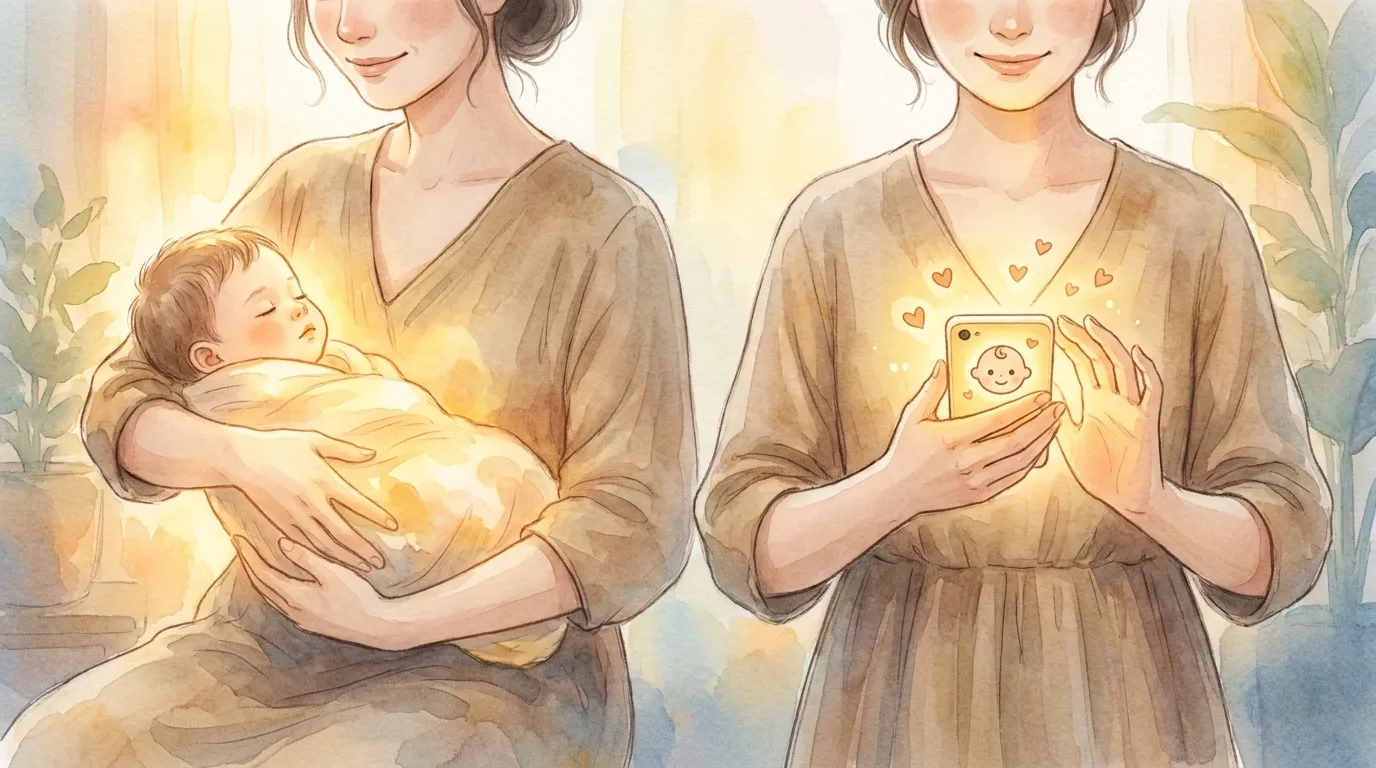
This is where AI companions and virtual baby apps come in. Research on the Tamagotchi Effect shows that caring for virtual beings activates the same nurturing pathways in the brain as caring for real ones.
Apps like AIdorable let you experience the emotional rewards of nurturing — feeding, playing, watching your virtual baby grow — without the life-altering commitment of actual parenthood.
Think of it as a "test drive" for your maternal instincts. You get the oxytocin hit without the 2 AM feedings.

5. Create a "Readiness Timeline"
Instead of fighting the feeling, use it productively. Write down the conditions under which you would want a baby:
- Financial stability target
- Relationship status
- Career milestone
- Personal goals to achieve first
This turns an emotional impulse into a rational plan.

The Bottom Line
Baby fever is your brain doing exactly what millions of years of evolution designed it to do: make you want to nurture. It's not a flaw, it's not weakness, and it's definitely not something to be ashamed of.
But it's also not a mandate. You get to decide when — or if — parenthood is right for you. In the meantime, there's nothing wrong with giving your nurturing instinct an outlet.
Whether that's fostering a kitten, babysitting your nephew, or adopting a virtual baby that grows with you — the oxytocin is real, and so is the satisfaction.
Related Articles
For the complete guide, see our Baby Fever & Maternal Instinct hub.
You might also find helpful: