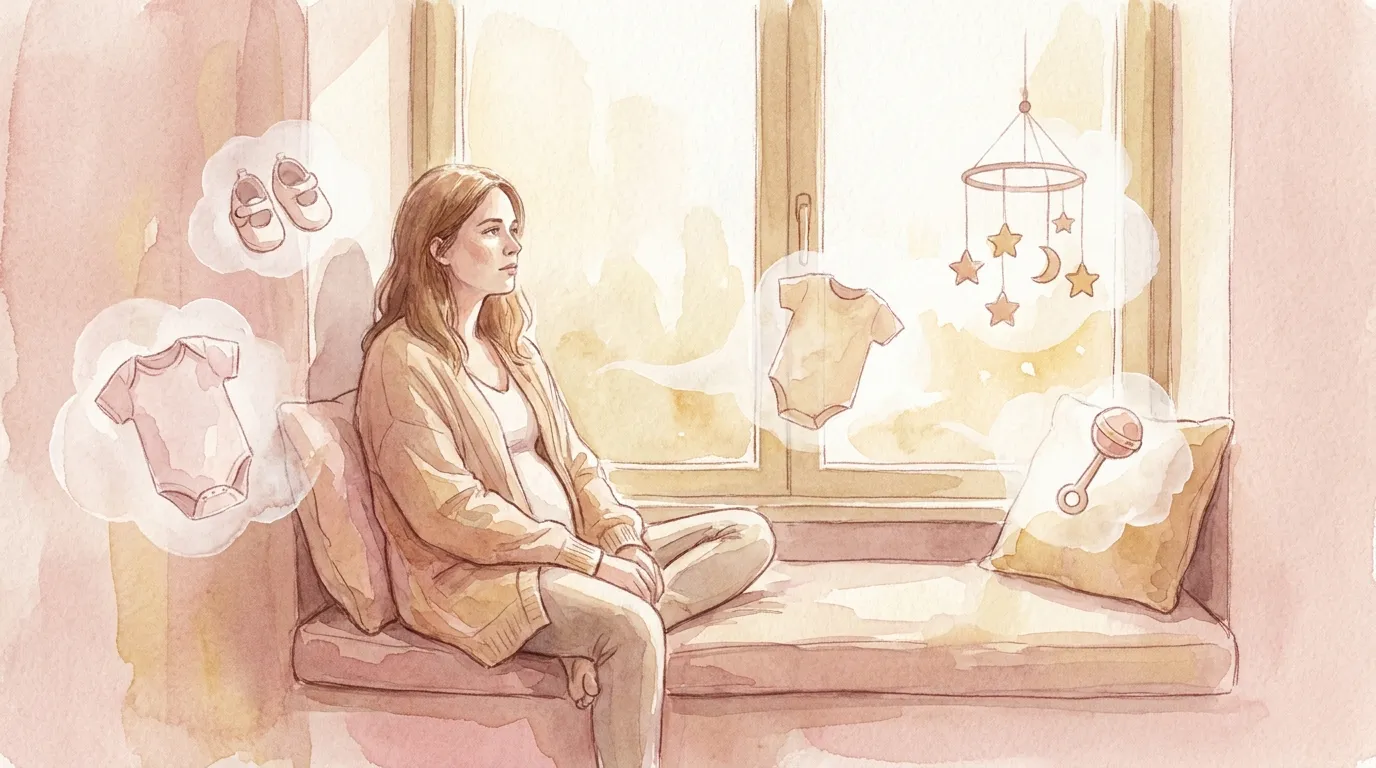
You're Not Weird. You're Broody.
There's a word for what you're feeling. It's not "crazy." It's not "desperate." It's not "pathetic."
It's broody.
And 8,100 women per month search for that exact word, trying to understand why they can't stop thinking about babies, why every infant face hits like a physical blow, why they're arranging their apartment like a nursery for a child that doesn't exist. For the full picture, see our complete baby fever guide.
Broodiness is real, it has a name, and it's nothing to be ashamed of.
Where the Word Comes From
"Broody" comes from agriculture. A broody hen is one who is driven — compulsively, unstoppably — to sit on her eggs. She stops eating normally. She stops socializing with other hens. She becomes single-mindedly focused on nurturing.
Sound familiar?
The agricultural term perfectly captures the human experience because the underlying drive is the same. Broodiness isn't a cultural phenomenon — it's a biological one. Your body has entered a state of heightened nurturing drive, and like the hen, you're finding it difficult to focus on anything else.
The difference: the hen has eggs to sit on. You might not. And that gap — between the drive and the outlet — is what makes broodiness feel so uncomfortable.
What Feeling Broody Actually Feels Like
Broodiness isn't one feeling. It's a cluster:
The Physical Component
- Chest tightness or warmth when you see babies
- A physical "pull" or "ache" in your torso
- Heightened sensitivity to baby cries (they feel louder, more urgent)
- Nesting behaviors (organizing, cleaning, decorating)
The Emotional Component
- Persistent thoughts about having a baby
- Emotional reactions to pregnancy announcements (joy, jealousy, or both)
- Vivid daydreams about caring for a baby
- Sadness or emptiness that doesn't have another clear cause
- Feeling "left behind" when friends have children
The Behavioral Component
- Spending time in baby sections of stores "just looking"
- Watching baby videos on social media more than usual
- Downloading baby-related apps
- Holding friends' babies longer than socially expected
- Researching fertility, parenting, or baby products
If you checked three or more from any category, you're broody. Welcome to the club. We have feelings and a lot of Pinterest boards.
Why You Feel Broody: The Three Triggers
1. Hormonal Activation
Your nurturing system has been turned up. Oxytocin sensitivity increases through your late 20s and 30s, making you more responsive to infant cues. Estrogen shifts amplify emotional sensitivity. Your body is literally producing more of the hormones that make you want to care for something small.
This isn't weakness — it's your neuroendocrine system working as designed.
2. Unmet Nurturing Need
The nurturing instinct creates a need — not a want, a need — for regular caregiving activity. If this need isn't met, it intensifies. The broodiness you're feeling might be your instinct getting louder because it's not being heard.
Think of it like hunger: skip lunch and by 3 PM, food is all you can think about. Skip nurturing for months and babies become all you can think about. Same mechanism, different need.
3. Life Stage Awareness
You're at an age where motherhood is becoming a decision rather than an abstraction. The question has moved from "someday" to "soon or never." This temporal pressure amplifies the underlying instinct, creating urgency that can feel overwhelming.
The Broody Scale: Where Are You?
Not all broodiness is equal. Here's a self-assessment:
| Level | Signs | What It Means |
|---|---|---|
| Mild | Notice babies more, occasional daydreams | Nurturing system warming up. Manageable. |
| Moderate | Regular baby thoughts, emotional reactions to pregnancy news, nesting behaviors | Instinct fully active. Needs an outlet. |
| Strong | Persistent baby focus, difficulty concentrating, researching fertility/pregnancy | Instinct demanding attention. Intervention needed. |
| Intense | All-consuming baby thoughts, crying over baby content, relationship strain | Instinct in overdrive. Professional support recommended. |
Most women fluctuate between mild and moderate. Strong and intense broodiness benefit from having a nurturing outlet — something to care for that satisfies the instinct without requiring life-altering decisions.
What to Do When You're Broody
1. Don't Fight It
Suppression doesn't work. Telling yourself "stop thinking about babies" makes you think about babies more. The instinct is a biological signal — ignoring it doesn't silence it, it amplifies it.
2. Find a Nurturing Outlet
The most effective treatment for broodiness is giving the instinct somewhere to go. Options:
- Virtual baby (AIdorable): 2 minutes/day, triggers real oxytocin, zero commitment
- Pet adoption: If your living situation allows, a pet provides daily nurturing
- Plant care: Start a garden or indoor plant collection
- Volunteering: Hospital baby cuddling programs, after-school tutoring, mentoring
- Friends' babies: Offer to babysit regularly — you get baby time without the 18-year commitment
The outlet doesn't need to be permanent. It needs to be regular (daily or near-daily) and interactive (it responds to your care).
3. Track Your Cycle
For many women, broodiness intensifies during ovulation (biological fertility window) and eases during menstruation. Tracking this pattern helps you distinguish hormonal broodiness from deeper readiness. If it's cyclical, it's biology. If it's constant, it's something more.
4. Separate Feeling from Decision
Broodiness says "nurture something." It does NOT say "get pregnant right now." These are different. You can honor the feeling without making any reproductive decisions. Give yourself permission to feel broody AND take your time deciding.
5. Talk About It
Broodiness thrives in silence. The less you talk about it, the more powerful and shameful it feels. Tell a friend. Tell your partner. Tell your therapist. The moment you say "I'm feeling really broody lately," it loses some of its grip.

When Broodiness Becomes a Problem
Broodiness crosses into problem territory when it:
- Interferes with your ability to focus on work or relationships
- Causes significant distress (crying frequently, anxiety, depression)
- Leads to impulsive decisions (stopping birth control without discussion, staying in a relationship only because you want a baby)
- Creates conflict in your relationship because you and your partner are on different timelines
If any of these apply, talk to a therapist who specializes in reproductive mental health. They can help you disentangle the instinct from the decision and find clarity.

The Broody Truth
Being broody is not a character flaw. It's not desperation. It's not weakness.
It's your body telling you that you have a deep capacity for nurturing — a capacity that is, right now, underutilized. The broodiness is the signal. What you do with the signal is your choice.
Maybe you'll have a baby. Maybe you won't. Maybe you'll adopt. Maybe you'll foster. Maybe you'll pour your nurturing into a career, or a community, or a garden that feeds your whole neighborhood.
But right now, in this moment, the broodiness is asking you to care for something. And that's a request worth honoring — even if the "something" is a virtual baby that fits in your phone and needs you for two minutes a day.
Because the nurturing instinct doesn't measure its satisfaction in years or commitments. It measures it in moments. In showing up. In the small daily act of caring for something outside yourself.
You're broody because you're capable of deep care. That's not a problem to solve.
That's a gift to use.
Related Articles
For the complete guide, see our Baby Fever & Maternal Instinct hub.
You might also find helpful:
- Baby Fever: What It Is, Why It Happens, and How to Handle the Urge
- Baby Fever Is Real: The Science Behind Why You Want a Baby (Even When You're Not Ready)
- 5 Signs Your Maternal Instinct Is Kicking In (And What to Do About It)
- How to Satisfy Baby Fever Without Getting Pregnant: 7 Safe Outlets That Actually Work