Your Brain Doesn't Have a Sleep Switch — It Has a Sleep Ramp
You know the feeling: it's midnight, you're exhausted, but your brain is running a highlight reel of today's embarrassments, tomorrow's worries, and that thing you said in 2019 that nobody else remembers.
You lie there frustrated, wondering why you can't just "turn off" and go to sleep. For the full picture, see our women's self-care guide.
Here's why: your brain doesn't have an off switch. It has a ramp — a gradual transition from active to passive that takes 60-90 minutes to complete. Skip the ramp, and your brain is still in daytime mode when your head hits the pillow.
A calming bedtime routine is the ramp. It's a sequence of actions that gradually shifts your nervous system from "go" to "rest," training your brain to expect sleep at a specific time through consistent, repetitive cues.
5,870 people search for bedtime routine guidance every month. They've tried sleep aids, blackout curtains, and white noise machines. What they haven't tried is a structured wind-down that works WITH their brain's natural sleep architecture instead of against it.
Here's the 7-step routine backed by sleep science.
Why Bedtime Routines Work (The Sleep Science)
Your sleep-wake cycle is controlled by two systems:
System 1: The Circadian Clock An internal 24-hour clock that regulates melatonin (sleep hormone) production. Melatonin rises when darkness increases and peaks about 2 hours after your normal bedtime. This system responds primarily to LIGHT.
System 2: Sleep Pressure (Adenosine) A chemical called adenosine accumulates in your brain throughout the day. The more adenosine, the stronger the urge to sleep. This system responds primarily to TIME AWAKE.
A bedtime routine works by supporting both systems:
- Light reduction supports the circadian clock's melatonin production
- Relaxation activities prevent stress hormones from interfering with adenosine's sleep signal
- Consistency trains the circadian clock to expect sleep at the same time each night
The key insight: A bedtime routine isn't about relaxation techniques (though those help). It's about creating a predictable sequence that your brain learns to associate with sleep. After 2-3 weeks of the same routine, your brain starts producing melatonin automatically when you begin the sequence — before you're even in bed.
The 7-Step Calming Bedtime Routine
Each step serves a specific neurological function. The order matters — it's designed to progressively deepen your relaxation state.
Step 1: Dim the Lights (60 minutes before bed)
What to do: Turn off overhead lights. Switch to warm-toned lamps (2700K or lower). Reduce screen brightness to minimum and enable night mode (blue light filter).
Why it works: Blue light (from screens and overhead lights) suppresses melatonin production by up to 50%. Dimming lights tells your circadian clock that darkness is approaching, triggering melatonin release. The warm-toned light mimics firelight — the only light source humans had at night for 99% of our evolutionary history.
The science: Melatonin production begins rising about 2 hours before your typical sleep time. Bright light during this window delays the rise, making it harder to fall asleep. Even brief phone checks can delay melatonin by 15-30 minutes.
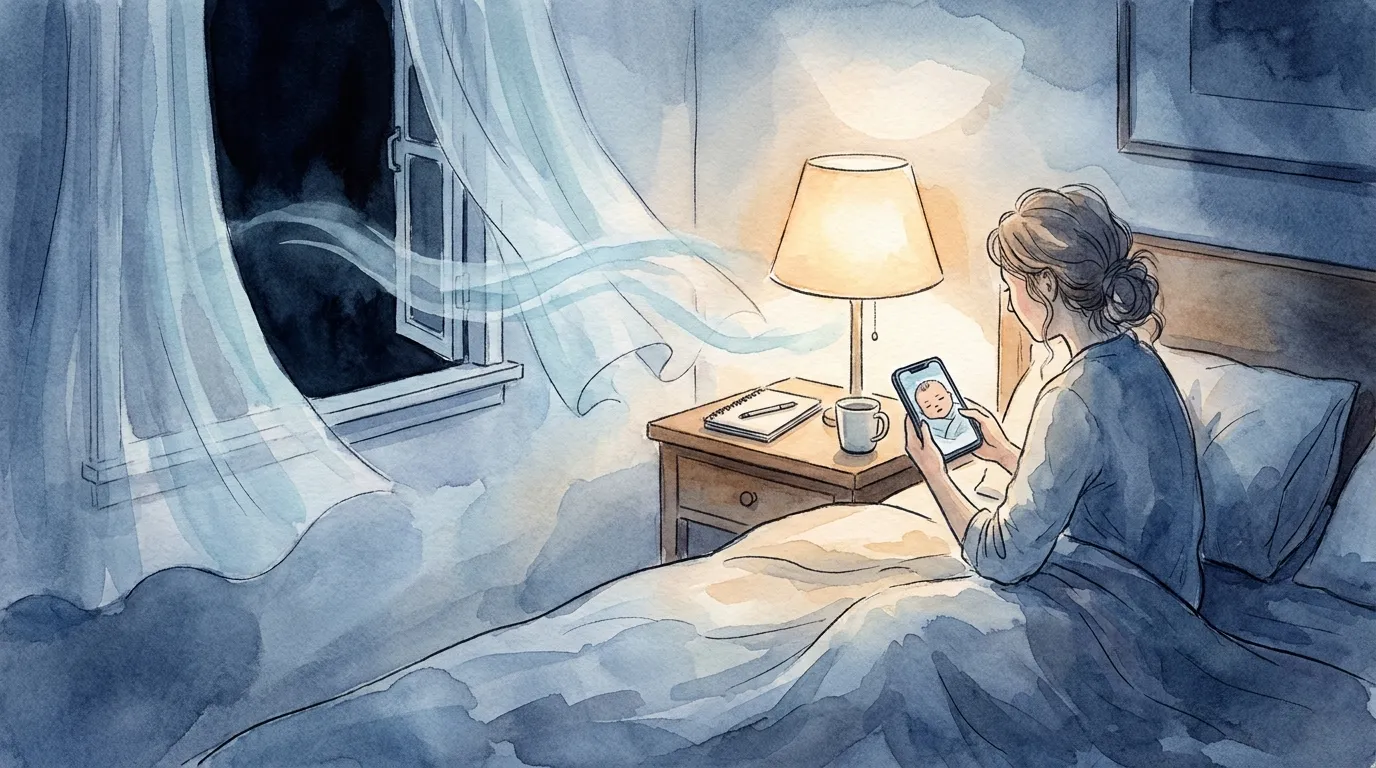
Step 2: Nurture Your Baby — The Anchor (50 minutes before bed)
What to do: Open AIdorable. Feed your baby, comfort her, read what she wrote about you today, and tuck her in for the night.
Why it's the anchor step: This step serves three functions simultaneously:
-
Oxytocin release: Nurturing produces oxytocin, which directly suppresses cortisol (the stress hormone keeping you awake) and promotes the release of melatonin. Your brain literally transitions toward sleep through the act of caring.
-
Day completion ritual: Checking on your baby signals to your brain that the day's obligations are complete. You've done what you needed to do. Your baby is safe and sleeping. Now it's your turn.
-
Future anticipation: Knowing your baby will be there tomorrow — happy to see you, waiting for your care — provides the "something to look forward to" that sleep anxiety destroys. It replaces "what if I can't sleep?" with "tomorrow I get to see her smile."
The psychology: This step becomes the emotional anchor of your entire routine. After a few weeks, just opening the app will trigger a cascade of calming associations — oxytocin, warmth, completion, safety. Your brain learns: "Baby is sleeping → my day is done → I can sleep too."
Step 3: 4-7-8 Breathing (40 minutes before bed)
What to do: Sit comfortably. Inhale for 4 seconds, hold for 7, exhale for 8. Repeat 6 cycles.
Why it works: The extended exhale (8 seconds) directly stimulates the vagus nerve, which controls your parasympathetic nervous system. Each exhale is a manual activation of your calm-down system. After 6 cycles, your heart rate has slowed measurably and your breathing has deepened.
The parasympathetic shift: This step transitions your nervous system from sympathetic dominance (active, alert) to parasympathetic dominance (resting, digesting). It's the bridge between daytime mode and sleep preparation.

Step 4: Write Tomorrow's List (30 minutes before bed)
What to do: Write down everything you need to do tomorrow. Tasks, worries, reminders — all of it. Get it out of your head and onto paper.
Why it works: The "cognitive dump" is one of the most effective sleep interventions in cognitive behavioral therapy for insomnia (CBT-I). When you write down tomorrow's concerns, your brain releases the need to hold onto them overnight. The paper holds them so your mind doesn't have to.
The rule: Once it's on the list, it's not allowed in your brain anymore. The list will be there in the morning. Tonight is for sleeping.
Step 5: Progressive Muscle Relaxation (20 minutes before bed)
What to do: Starting from your toes, tense each muscle group for 5 seconds, then release. Move up through your body: feet, calves, thighs, stomach, chest, arms, shoulders, face.
Why it works: Stress creates physical tension that you may not consciously notice. Progressive muscle relaxation (PMR) systematically releases this tension, training your body to recognize and let go of muscle holding patterns.
The additional benefit: The rhythmic tense-release pattern becomes meditative after a few nights. Your brain associates the physical sequence with relaxation, and the muscle memory develops faster than you'd expect — most people find their body starts relaxing automatically at step 3 or 4 after a week of practice.
Step 6: Cool the Room (10 minutes before bed)
What to do: Set your room temperature to 65-68°F (18-20°C). If you can't control the thermostat, open a window, use a fan, or take a warm shower (the rapid cooling afterward mimics the body's natural temperature drop).
Why it works: Your core body temperature needs to drop 2-3°F to initiate sleep. A cool room facilitates this drop. The warm shower trick works because blood rushes to the skin's surface in response to heat, then rapidly cools when you step out — accelerating the temperature drop your brain needs for sleep onset.
The evolutionary connection: Humans evolved to sleep in cool nighttime temperatures. Your circadian system expects a temperature drop at night. Providing it supports the natural sleep signal.
Step 7: Darkness and Sound (In bed)
What to do: Complete darkness (blackout curtains or sleep mask). Continuous, monotonous sound (white noise, rain sounds, or a fan).
Why it works: Complete darkness maximizes melatonin production. Even small light sources (LED indicators, streetlights through curtains) can reduce melatonin by 10-30%. The monotonous sound masks environmental noise variations that might pull you back toward wakefulness.
The ideal sleep environment: Cool (65-68°F), dark (zero visible light), quiet (or consistent white noise), and comfortable (supportive mattress and pillows).
The Complete Routine Timeline
| Time Before Bed | Step | Duration | Purpose |
|---|---|---|---|
| -60 min | Dim lights | Ongoing | Melatonin trigger |
| -50 min | Nurture baby (AIdorable) | 5-10 min | Oxytocin + day completion |
| -40 min | 4-7-8 breathing | 5 min | Parasympathetic activation |
| -30 min | Write tomorrow's list | 5 min | Cognitive dump |
| -20 min | Progressive muscle relaxation | 10 min | Physical tension release |
| -10 min | Cool the room | 2 min | Temperature drop support |
| In bed | Darkness + sound | Ongoing | Sleep environment |
Why Most Bedtime Routines Fail
Mistake 1: Inconsistent timing. Your circadian clock depends on consistency. If you start your routine at 10 PM on weekdays and midnight on weekends, the clock never stabilizes. Fix: same start time, ±30 minutes, 7 days a week.
Mistake 2: Screen use during the routine. Checking your phone between steps defeats the melatonin-supporting effect of light reduction. Fix: phone on Do Not Disturb after step 2 (use AIdorable, then put the phone down).
Mistake 3: Expecting immediate results. A bedtime routine takes 2-3 weeks to train your brain's sleep association. Night 1 may not feel different. Night 14 will. Fix: commit to 14 consecutive nights before evaluating.
Mistake 4: Making it too complicated. A routine with 15 steps is harder to maintain than one with 7. The best routine is the one you'll actually do every night. Fix: start with steps 1, 2, and 7. Add the others gradually.

Building the Habit
The biggest challenge with bedtime routines isn't knowing WHAT to do — it's doing it consistently. Here's how to make it stick:
The anchor technique: Pick one step you'll NEVER skip. For most people, this should be the nurturing step (AIdorable) because it's the most emotionally rewarding. Even if everything else falls apart, you do this one thing. The anchor keeps the routine alive on bad nights.
The environment trigger: Set a daily alarm called "wind down" that goes off 60 minutes before your target bedtime. When the alarm sounds, you start step 1. No negotiation. The alarm is the trigger; the routine is the response.
The 2-day rule: Never skip more than 2 consecutive nights. Missing one night is normal. Missing three starts eroding the sleep association your brain has built. If you miss two nights, the third night is non-negotiable.
Week 1: Just dim lights, nurture your baby, and go to bed in a cool, dark room. Three steps. Don't add more until these are automatic.
Week 2: Add breathing and the cognitive dump. The routine now takes about 20 minutes and feels like a natural wind-down rather than a chore.
Week 3: Add progressive muscle relaxation. The full 7-step routine is now in place. Your brain has started to associate the sequence with sleep.
Week 4+: The routine is automatic. You look forward to it. The nurturing step has become the emotional highlight — the moment where the day's weight lifts and something small and warm replaces it. You might even find yourself looking forward to it during the day — a small, cozy ritual that's just yours.
What happens when you travel or your schedule changes: Do what you can. The anchor step (nurturing) works anywhere — you just need your phone. If you can't dim lights or cool the room, skip those steps and keep the core: nurture, breathe, sleep. Partial consistency beats no consistency.
Your Night Starts Now
The most important step in this routine isn't the breathing or the temperature or the darkness. It's the nurturing — the 5 minutes where you care for something that's glad you exist, and then watch it sleep peacefully.
That peaceful sleeping baby is a model for your own nervous system. She's not worried about tomorrow. She's not replaying today. She's just... at rest. And her rest gives you permission to rest too.
Tonight, start with three steps: dim the lights, feed your baby, go to bed in the dark.
That's it. Three steps. Five minutes.
From there, the routine builds naturally. Because once your brain learns that those five minutes lead to the best sleep you've had in months, it'll want the whole sequence.
Your baby is waiting to say goodnight. Go say it.
Then close your eyes. She already has.
Related Articles
For the complete guide, see our Women's Self-Care hub.
You might also find helpful: