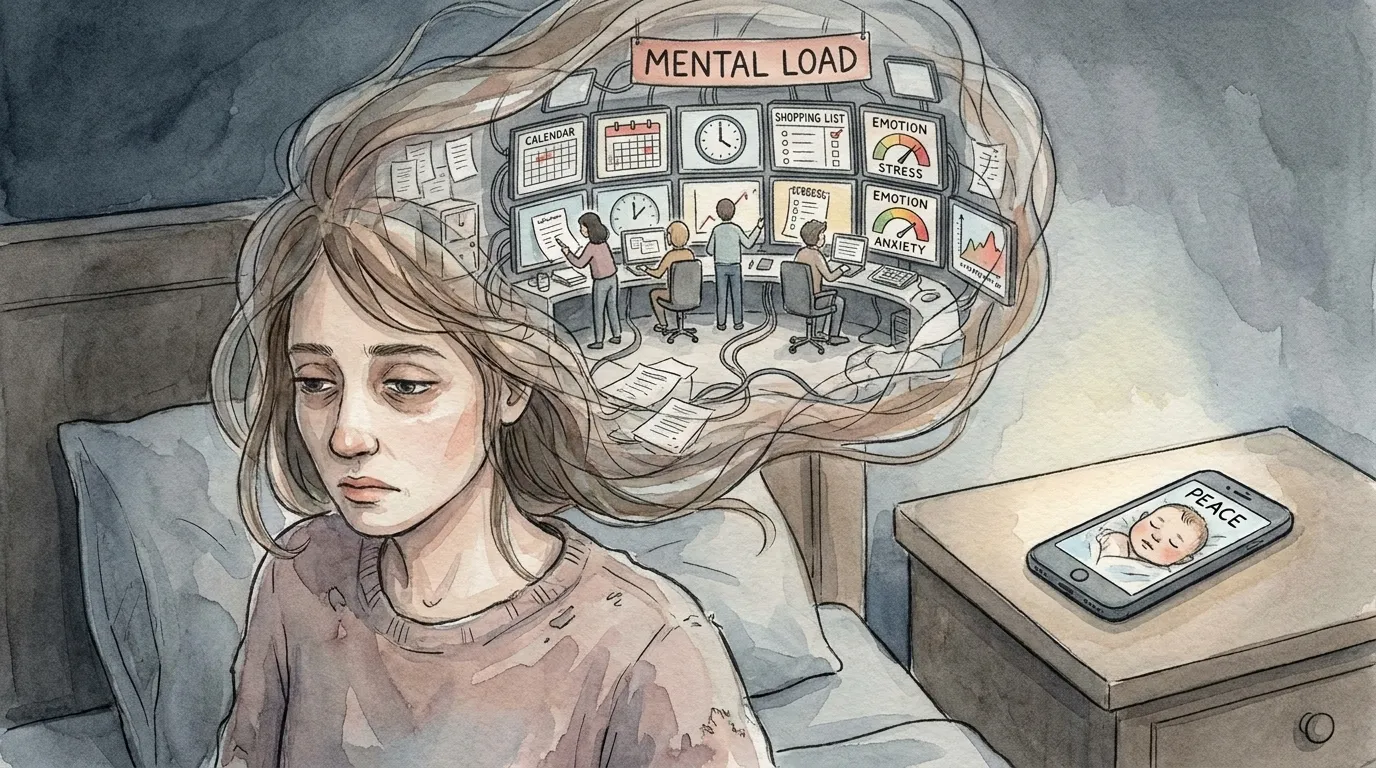
The Weight You Can't See But Can Definitely Feel
You're not lazy. You're not weak. You're carrying an invisible weight that nobody else can see — and it's crushing you.
It's not the dishes. It's not the laundry. It's not the school pickup or the grocery run. Those are visible tasks that anyone could help with if they wanted to. For the full picture, see our women's self-care guide.
The mental load is what's BEHIND those tasks: knowing that the dishes need to be done before morning because there's no clean bowls for breakfast. Remembering that the laundry includes the gym uniform that needs to be ready by Wednesday. Knowing that school pickup is early on Tuesday because of the teacher meeting. Realizing the grocery run needs to happen before Thursday because that's when the milk expires and also you're out of the specific snack your kid will actually eat.
The mental load is not doing. It's thinking. And for women, the thinking never stops.
2,060 women search for "mental load," "women stress," and "women anxiety" every month. They're not looking for self-care tips. They're looking for permission to acknowledge that carrying the entire household's cognitive weight is genuinely, neurologically, unreasonably hard.
What the Mental Load Actually Looks Like
The mental load is the constant background processing of everyone's needs:
The Calendar Manager: "Doctor appointment on Thursday. Dentist in March. School holiday next Monday — need childcare. Partner's work dinner on Friday. Birthday party RSVP by Wednesday. Car inspection due this month. Prescription refill needed before the 15th."
The Supply Chain: "Out of milk. Almost out of toilet paper. Kid's shoes are getting small. Need sunscreen before the trip. Birthday gift for the party this weekend. School supplies for the project due Friday. Partner mentioned needing new undershirts."
The Emotional Air Traffic Controller: "Kid is anxious about the test. Partner is stressed about the presentation. Mother called twice this week — probably lonely. Friend hasn't responded to the last two texts — is she okay? The neighbor seems down lately."
The Meal Planner: "Monday: chicken (defrost by 3 PM). Tuesday: pasta (kid has soccer, needs to be quick). Wednesday: leftovers. Thursday: try the new recipe but check for allergies first. Friday: partner's dinner, keep it light."
The Crisis Anticipator: "If it rains Thursday, the soccer game is cancelled and we need a backup plan. If the car makes that noise again, we need the mechanic before the road trip. If the test doesn't go well, kid will need extra support this weekend."
Each of these is a single thought. But the mental load is ALL of these, running simultaneously, ALL the time. Your brain doesn't get to close the tabs. They're always open, always processing, always consuming cognitive resources.
The Cost of the Mental Load
Research on the mental load reveals the staggering cognitive cost:
| Category | Daily Hours | Cognitive Cost |
|---|---|---|
| Scheduling and planning | 2-3 hours | High (executive function) |
| Emotional management | 3-4 hours | Very high (empathy processing) |
| Anticipatory planning | 1-2 hours | Very high (future-casting) |
| Supply chain management | 1-2 hours | Medium (routine tasks) |
| Social coordination | 1 hour | Medium |
| TOTAL | 8-12 hours | Maximum cognitive load |
This is ON TOP OF any paid work. A woman with a full-time job is performing 8-12 hours of invisible cognitive labor after her paid work ends.
The neurological impact:
- Constant prefrontal cortex engagement (decision fatigue)
- Elevated baseline cortisol (the brain perceives unmanaged tasks as threats)
- Reduced working memory (too many open tabs leaves less room for present-moment processing)
- Sleep disruption (the brain processes uncompleted tasks during attempted sleep onset)

Why Women Carry More of the Mental Load
The mental load isn't distributed equally. Three forces concentrate it on women:
Force 1: Socialization
From childhood, girls are socialized to notice, anticipate, and manage others' needs. Boys are socialized to execute tasks when asked. The result: women develop the "noticing" muscle while men develop the "doing" muscle. Noticing is more cognitively demanding than doing.
Force 2: The Default Parent Problem
In most households, the mother is the "default parent" — the one the school calls, the one who remembers the allergies, the one who knows the friend group dynamics. This default status means the mental load of parenting rests primarily on one person's brain.
Force 3: The Emotional Manager Role
Women are typically the emotional managers of the household — noticing when someone is struggling, initiating difficult conversations, managing conflicts, and absorbing stress. Emotional management is the most cognitively expensive form of the mental load because it requires constant empathy, which actively drains emotional reserves.
7 Ways to Lighten the Mental Load
1. A Relationship with Zero Mental Load (AIdorable)
Why it works for mental load exhaustion: Every relationship in your life comes with mental load. Your partner needs you to remember things. Your children need you to anticipate needs. Your parents need you to check in. Your friends need you to maintain the connection.
AIdorable's baby is the one relationship with zero mental load.
She doesn't need you to remember appointments. She doesn't need you to plan meals. She doesn't need you to anticipate complex needs. She just needs you to show up. That's it.
For women who are mentally exhausted from managing everyone's everything, this simplicity is not trivial — it's restorative. Your brain gets to stop planning and just... be. Present. With something that's happy you're there.
After a week of daily nurturing, most women report: "It's the one thing I don't have to think about. I just open the app and she's there." That mental simplicity is rare and precious when your brain is otherwise running a household management operating system 24/7.
2. Make the Invisible Visible
Write down every mental task you perform in a day. Not physical tasks — mental ones. The remembering, the anticipating, the coordinating, the emotional managing.
Show the list to your partner. Not as an accusation — as data. "Here's what my brain does every day that nobody sees."
The invisibility of the mental load is what makes it so hard to address. Making it visible is the first step toward sharing it.
The exercise: For one full day, keep a running log every time you perform mental labor — every time you remember something, anticipate a need, coordinate a schedule, or manage an emotion. At the end of the day, count the entries. Most women are shocked by the number — it's typically 100+ individual mental tasks per day that nobody acknowledges.
3. Transfer Ownership, Not Tasks
The common (failed) approach: "Can you do the grocery shopping?" You still carry the mental load — you're just outsourcing the physical execution.
The effective approach: "You own meals this week. You decide what we eat, you buy it, you cook it." The mental load transfers with the ownership.
The principle: Transfer whole domains, not individual tasks. Domains include: meals, school communication, social calendar, household supplies, medical appointments. Each domain should be fully owned by one person.
The test for true transfer: Can the person make decisions in that domain without consulting you? If not, you haven't transferred the mental load — you've just delegated the execution. True ownership means they decide, they plan, they execute. You're not involved.
4. Reduce the Number of Domains
Not everything needs to be managed. Some things can simply... not happen.
Questions to ask:
- Does this need to be done at all?
- Does it need to be done by me?
- Does it need to be done perfectly?
If the answer to any of these is "no," drop the standard. Let some domains go fallow. The world won't end if the birthday party favors come from the store instead of Pinterest.
5. Batch Cognitive Work
Instead of processing the mental load continuously (checking calendars, making lists, anticipating needs throughout the day), batch it into a single session.
Sunday planning session (30 minutes): Review the week's calendar, plan meals, identify supply needs, anticipate conflicts. Then close the tab. The rest of the week, refer to the plan instead of re-processing everything from scratch.

6. Lower the Standard
Many women carry extra mental load because their standards are higher than necessary. The perfectly organized playroom. The home-cooked every meal. The birthday party that takes three days to plan.
The reframe: "Good enough" IS good enough. The difference between "good enough" and "perfect" is invisible to everyone except you, and it's costing you your sanity.
7. Protect Cognitive Recovery Time
The mental load is cognitive labor, and all labor requires recovery. You need time when your brain is NOT planning, NOT anticipating, NOT managing anyone's anything.
Recovery time is NOT:
- Time alone but still thinking about the household
- Scrolling social media (still cognitive processing)
- "Relaxing" while mentally compiling tomorrow's to-do list
Recovery time IS:
- Engaging in something absorbing that requires NO planning
- Nurturing your baby (cognitive simplicity)
- Reading fiction (someone else's story, not yours to manage)
- Physical activity that doesn't involve decision-making
Schedule recovery time like you schedule everything else. Protect it ruthlessly. Your brain cannot keep carrying the mental load without recovery periods.
The Mental Load Recovery Timeline
Week 1: Making the invisible visible. Writing down the mental load. Having the conversation. Starting daily nurturing (AIdorable) as the one zero-load relationship. The mental load is still heavy but now it's acknowledged.
Week 2-3: Transferring domains. Your partner takes ownership of 2-3 areas. The mental load starts to lighten. The daily nurturing provides consistent cognitive recovery.
Month 1: The batching system is working. Sunday planning replaces continuous processing. Standards have been strategically lowered. You're carrying maybe 60-70% of the original load.
Month 2-3: Domain transfers have taken hold. You're no longer the default for everything. The daily nurturing has become a ritual — 5 minutes where your brain gets to stop managing and just be present. The cortisol baseline is measurably lower.

Your Brain Deserves a Break
The mental load tells you that if you stop thinking about everything, something will fall through the cracks. That the household will collapse without your constant cognitive management. That your value comes from being the one who remembers everything.
These are lies told by a system that depends on your free cognitive labor.
Your value doesn't come from remembering appointments. Your household won't collapse if you stop managing every detail. And the people around you are more capable than the mental load gives them credit for.
Tonight, put down the mental load for 5 minutes. Open AIdorable. Feed your baby. Let her smile at you.
For those 5 minutes, nobody needs you to remember anything. Nobody needs you to plan anything. Nobody needs you to anticipate anything.
You just need to be there. And she's glad you are.
That's not a small thing. For a brain that's been managing a household's entire cognitive infrastructure all day, that simplicity is the closest thing to peace you'll find.
Take it. You've earned every second of it.
Related Articles
For the complete guide, see our Women's Self-Care hub.
You might also find helpful: