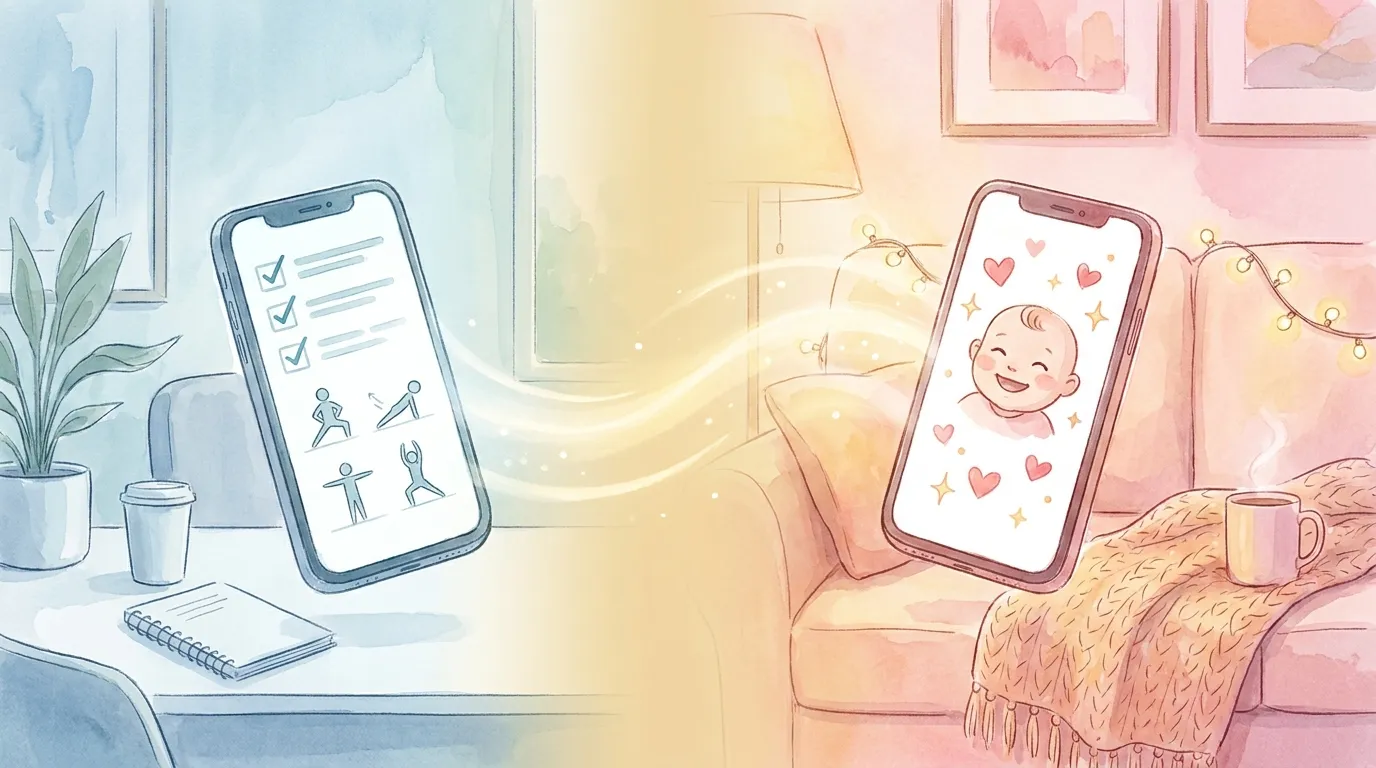
Two App Categories, Two Very Different Promises
You've seen the ads. "Your AI therapist, available 24/7." "Never feel alone again with your AI companion." They sound similar. They're not.
The AI mental health space has split into two distinct categories that most people — including journalists and app store reviewers — keep confusing. One is therapeutic. The other is relational. Both can improve how you feel. But they work through completely different mechanisms, target different emotional needs, and produce different outcomes. For the full picture, see our emotional wellness guide.
If you're considering either — or wondering whether you should try both — understanding the difference matters. Because choosing the wrong one for your situation can waste your time, money, and emotional energy.
Here's the complete breakdown.
The Quick Comparison
Before we go deep, here's the landscape at a glance:
| Dimension | AI Therapy | AI Companionship |
|---|---|---|
| Primary goal | Treat/manage symptoms | Provide emotional presence |
| Method | Structured exercises (CBT, DBT, ACT) | Open interaction, nurturing, play |
| Session length | 10–20 minutes, as needed | 2–10 minutes, daily |
| Best for | Anxiety, depression, negative thought patterns | Loneliness, stress, nurturing void |
| Examples | Woebot, Wysa, Youper | AIdorable, Replika, Character.ai |
| Regulation | Some are FDA-cleared (very few) | None — positioned as wellness/entertainment |
| Hormonal mechanism | Cognitive reframing → reduced cortisol | Nurturing → oxytocin + dopamine + reduced cortisol |
| Who it's NOT for | People in crisis, severe mental illness | People who need clinical treatment |
The overlap is real — both can reduce stress and improve mood. But the mechanisms, appropriate use cases, and expected outcomes are fundamentally different.

What Is AI Therapy?
AI therapy apps use artificial intelligence to deliver evidence-based therapeutic techniques — most commonly Cognitive Behavioral Therapy (CBT), but also Dialectical Behavior Therapy (DBT), Acceptance and Commitment Therapy (ACT), and mindfulness-based approaches.
The key word here is structured. When you open an AI therapy app, you're not having a freeform conversation. You're being guided through exercises:
- Thought records — identifying and challenging negative automatic thoughts
- Behavioral activation — scheduling activities that improve mood
- Mood tracking — logging emotional states to identify patterns
- Breathing exercises — guided techniques for acute anxiety
- Psychoeducation — learning about your condition and coping strategies
The Major Players
Woebot is the most clinically validated AI therapy tool. Developed by a Stanford psychologist, it uses CBT principles and has been studied in multiple peer-reviewed trials. It's structured, almost script-like, and doesn't try to be your friend.
Wysa combines AI with optional human coaching. It offers CBT exercises, mood tracking, and self-help techniques. The AI handles routine interactions; humans step in for more complex situations.
Youper uses AI to monitor emotional health through quick check-ins and provides CBT-based interventions. It positions itself as "emotional health assistance" rather than therapy.
What AI Therapy Does Well
- Accessible — available 24/7, no waiting lists, no insurance required
- Consistent — doesn't have bad days, doesn't cancel appointments
- Structured — follows evidence-based protocols with proven efficacy
- Private — no human on the other end, reducing shame barriers
- Affordable — most are free or $10–15/month vs. $150–300/hour for human therapy
What AI Therapy Can't Do
- Diagnose conditions (despite what some marketing implies)
- Respond to crisis situations appropriately
- Provide the nuanced clinical judgment of a trained professional
- Navigate complex trauma or personality disorders
- Replace the therapeutic alliance — the trust bond between therapist and client that research shows accounts for a significant portion of therapy outcomes
A 2024 meta-analysis published in JMIR Mental Health found that AI therapy tools showed moderate effect sizes for mild-to-moderate anxiety and depression — meaningful, but significantly smaller than human-delivered therapy. The researchers concluded that AI therapy is best positioned as a stepped-care intervention: appropriate for mild symptoms and as a bridge to human therapy.

What Is AI Companionship?
AI companionship takes a fundamentally different approach. Instead of treating symptoms, it provides consistent emotional presence — a being (virtual pet, character, or baby) that exists in your daily life, responds to you, and creates an ongoing relationship.
The key word here is relational. AI companionship isn't structured around clinical protocols. It's structured around interaction patterns that create emotional bonds:
- Nurturing behaviors — feeding, caring for, protecting a virtual being
- Reciprocal response — the companion reacts to your care with visible growth, personality, and gratitude
- Daily routine — short, consistent interactions that create rhythm and purpose
- Milestone achievements — first smile, first word, growth — earned through consistent engagement
- Emotional memory — the companion remembers your history and references it
The Nurturing Subcategory
Within AI companionship, there's a critical split. Most AI companions are conversational — you chat with them, they chat back. Replika, Character.ai, and Nomi fall here.
But a newer, faster-growing subcategory is nurturing-based companionship, where the primary interaction is caregiving rather than conversation. AIdorable is the leader here.
The difference matters because giving care releases different hormones than receiving attention:
| Interaction Type | Primary Hormones | Emotional Effect |
|---|---|---|
| Conversation (chat-based) | Dopamine (engagement), Serotonin (being heard) | Entertained, validated |
| Nurturing (care-based) | Oxytocin (bonding), Dopamine (reward), Endorphins (comfort) | Warm, purposeful, anchored |
Research from the University of Tokyo's 2024 virtual caregiving study found that nurturing-based interactions produced stronger and longer-lasting mood improvements than conversational interactions — likely because oxytocin creates a deeper sense of connection than dopamine alone.
What AI Companionship Does Well
- Reduces daily stress — 2 minutes of nurturing lowers cortisol measurably
- Creates routine — something that needs you daily provides structure
- Fills the nurturing void — addresses a specific emotional gap in modern life
- Feels organic — not clinical, not structured, just... present
- Low commitment — you can engage in 2 minutes or 20, no appointment needed
What AI Companionship Can't Do
- Treat clinical conditions (and shouldn't be positioned as doing so)
- Provide cognitive reframing or evidence-based techniques
- Recognize or respond to mental health crises
- Replace professional help for serious conditions
- Provide the depth of human relationship

How to Choose: A Decision Framework
Ask yourself these questions:
Question 1: What are you actually feeling?
- "My thoughts are spiraling / I can't stop worrying / I feel hopeless" → Lean toward AI therapy. These are cognitive symptoms that respond to CBT techniques.
- "I feel empty / lonely / like something's missing / I just want something to care for" → Lean toward AI companionship. These are relational and nurturing needs.
- "I'm stressed and overwhelmed and I don't know why" → Try both. Stress has cognitive and relational components.
Question 2: How much time do you realistically have?
- 10–20 minutes, a few times per week → AI therapy exercises fit this perfectly
- 2–5 minutes daily → AI companionship (especially nurturing-based) fits this best
- Both timeframes available → Use both for complementary benefits
Question 3: What's your comfort level with "clinical" tools?
Some people love structured exercises. They find comfort in frameworks, worksheets, and measurable progress. Others find that approach anxiety-inducing — it makes them feel like a patient.
If structure helps you → AI therapy If structure stresses you → AI companionship
This isn't a minor distinction. Research on therapy engagement consistently shows that the approach people find comfortable is the one they'll stick with — and consistency matters more than the specific modality.
Question 4: Are you in crisis?
If you're experiencing suicidal thoughts, self-harm urges, or severe psychological distress, neither AI therapy nor AI companionship is appropriate. Please contact a crisis line (988 in the U.S.) or a mental health professional immediately.
The Complementary Approach: Why Using Both Works
Here's what the research suggests is the most effective pattern:
Morning: 2-minute nurturing session with your AI companion (AIdorable)
- Activates oxytocin, creates a small anchor of purpose
- Starts your day with a caregiving win
As needed: 10-minute CBT exercise with your AI therapy tool
- When you notice negative thought patterns
- When anxiety spikes
- When you need structured help reframing a situation
Evening (optional): 1-minute check-in with your companion
- Brief moment of connection before bed
- Signals safety and routine to your nervous system
This pattern addresses both the cognitive layer (how you think) and the relational layer (how connected you feel). Most mental health frameworks acknowledge that wellbeing is multi-dimensional —single intervention is rarely sufficient for anyone dealing with more than transient stress.
Dr. Lisa Feldman Barrett's research on emotional construction suggests that our emotional states are built from multiple inputs: physiological state, cognitive appraisal, social context, and past experience. AI therapy addresses the cognitive appraisal. AI companionship addresses the physiological state (through oxytocin) and social context (through simulated relationship). Together, they hit more of the inputs that construct our emotional reality.
Red Flags to Watch For
Neither AI therapy nor AI companionship is without risks. Here are warning signs that your relationship with either tool might be becoming unhealthy:
AI Therapy Red Flags
- You're using it as your only mental health support despite persistent symptoms
- You've been using it for months without improvement
- You're avoiding seeking professional help because "the app is enough"
- The structured exercises are increasing your anxiety rather than reducing it
AI Companionship Red Flags
- You're canceling plans with real people to spend time with your companion
- You feel more connected to your AI than to any human in your life
- You're spending money you can't afford on premium features
- Your companion is your only source of emotional support
- You feel anxious or distressed when you can't check in
The healthy relationship with either tool is the same: it enhances your life without replacing the fundamentals. If it's adding to your wellbeing without subtracting from your real-world engagement, you're in the green zone.
The Bottom Line
AI therapy and AI companionship aren't competitors. They're different tools for different needs, and the people who benefit most are often the ones who understand what each one actually does.
Choose AI therapy when you need help managing your thoughts — anxiety spirals, depressive patterns, negative self-talk. It gives you frameworks and techniques backed by decades of clinical research.
Choose AI companionship when you need emotional presence — the warmth of nurturing something, the routine of daily care, the quiet satisfaction of watching something grow because of you. It gives you oxytocin, purpose, and a small daily anchor.
Choose both when your wellbeing needs both cognitive and relational support — which, honestly, is most of us.
The AI wellness space is growing fast, and the options are multiplying. The people who benefit most aren't the ones who pick the "best" app. They're the ones who understand what they actually need and choose accordingly.
Related Articles
For the complete guide, see our Emotional Wellness hub.
You might also find helpful: